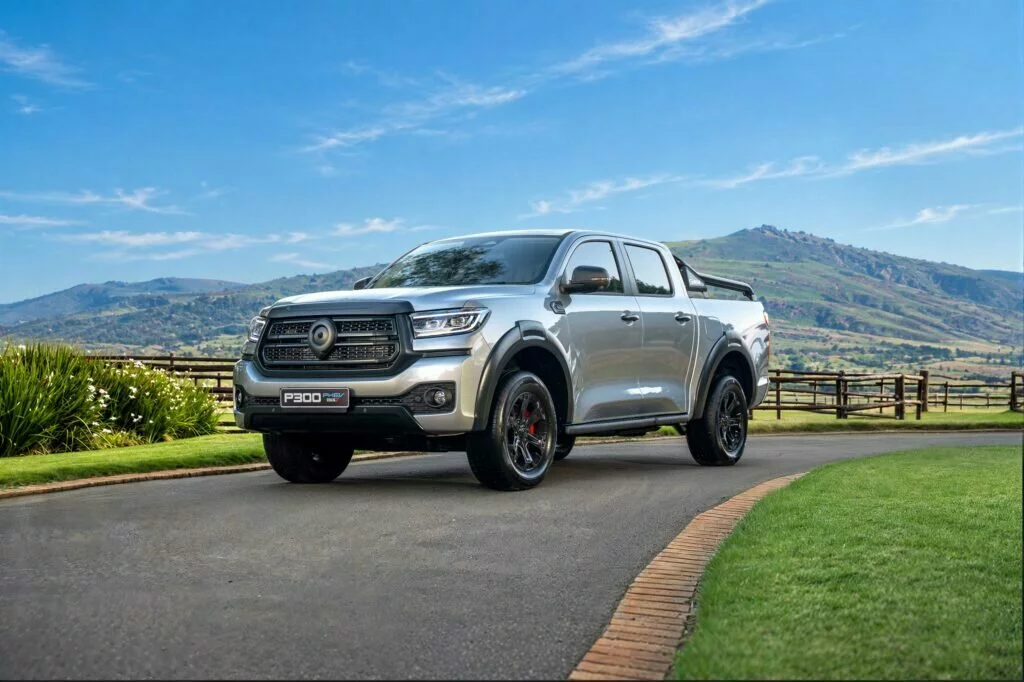
GWM’s First Electrified P300 Bakkie Packs 310 kW, 750 Nm and 115 km of Electric Range

GWM's First Electrified P300 Bakkie Packs 310 kW, 750 Nm and 115 km of Electric Range

October 7, 2026

Quick Facts

  • The P300 D-Cab 2.0T Pioneer Hi4-T PHEV is the first electrified derivative in GWM’s P300 bakkie range
  • A 2.0-litre turbo petrol engine and 130 kW electric motor deliver a combined 310 kW and 750 Nm
  • 33.1 kWh LFP battery provides up to 115 km of electric-only range (NEDC), with combined fuel consumption of 2.4 l/100 km
  • DC fast charging at up to 110 kW, and 30% to 80% in about 18 minutes
  • Low-range 4WD, a rear diff lock and a 3,500 kg braked towing capacity
  • Priced at R914,900, with a 7-year/200,000 km warranty and 8-year/150,000 km battery warranty

GWM South Africa has added the first electrified derivative to its P300 bakkie line-up. The new P300 2.0T Pioneer Hi4-T PHEV is a plug-in hybrid that can handle the school run and the daily commute on electricity alone, while keeping the performance, four-wheel-drive hardware and off-road ability buyers expect when the weekend calls for something tougher.

How the Hi4-T powertrain works

The P300 PHEV pairs a hybrid-dedicated 2.0-litre turbo petrol engine, producing 180 kW and 380 Nm, with GWM’s nine-speed automatic transmission. Built into that transmission is a 130 kW electric motor delivering 495 Nm, giving the bakkie a combined output of 310 kW and 750 Nm.

Where many plug-in hybrids lean heavily on their electric motor while charge is available, the P300’s engine and motor work in parallel. The motor provides instant torque at low speeds, while the petrol engine runs within its most efficient band. Because the engine keeps driving the wheels when the battery runs low, performance stays consistent on long climbs and under heavy loads, conditions that can catch out conventional plug-in hybrid systems.

Drivers can choose between three power modes. Electric Mode keeps things quiet and free of tailpipe emissions on shorter trips, while Hybrid Mode blends engine and motor for longer journeys and highway driving. Intelligent Mode lets the driver hold the battery’s state of charge between 30% and 80%, and includes a Camping Mode that reserves battery capacity for running appliances and equipment off the grid.

Commuting on electricity, charging in minutes

The battery is a 33.1 kWh lithium iron phosphate (LFP) unit using short-blade laminated cells. It offers up to 115 km of electric-only driving on the NEDC cycle, enough for most daily commutes without starting the engine, and combined fuel consumption is rated at 2.4 l/100 km.

DC fast charging runs at up to 110 kW, taking the battery from 30% to 80% in about 18 minutes in normal temperatures. The pack sits on the frame rails for protection off-road, carries an IP68 dust and water rating and has passed a 28-day salt-spray corrosion test.

Vehicle-to-Load (V2L) turns the P300 into a power source, supplying up to 6 kW when parked and 4 kW on the move through two outlets. That’s enough for camping appliances, power tools on a job site or equipment far from mains power, with no generator required. When the battery runs low, the engine can top it up automatically.

Still a proper bakkie underneath

Electrification hasn’t softened the P300’s working credentials. It rides on a body-on-frame chassis with double-wishbone front suspension and a rigid rear axle with a 3+2 leaf-spring setup, built for hard work and towing.

A part-time four-wheel-drive system offers 2H, 4H and 4L, with low range providing a 2.64:1 reduction ratio for steep climbs, tough terrain and recoveries. An electronically controlled rear differential lock is standard, along with selectable drive modes, an All-Terrain Feedback System, Off-Road Expert Mode and underbody protection.

Ground clearance is 200 mm, with a 26-degree approach angle, a 23-degree departure angle (21 degrees with a tow bar fitted) and a 19-degree breakover angle.

Braked towing capacity is 3,500 kg. A dedicated Trailer Driving Mode switches on automatically when a trailer is plugged into the tow socket, disabling driver-assistance functions that could trigger false alerts and moving the powertrain to a towing-specific calibration.

Blacked-out styling and an SUV-grade cabin

The P300 PHEV measures 5,416 mm long, 1,947 mm wide and 1,886 mm tall, on a 3,230 mm wheelbase. A black grille, blacked-out headlamp and tail-lamp clusters, black door handles, mirror caps and wheel arches, and black alloy wheels on 265/60 R18 tyres give it a sportier look, finished off with red brake callipers. Automatic LED headlamps with High Beam Assist, fixed side steps and a spray-in load-bin liner are standard. White is the standard colour, with Red, Blue, Silver, Grey and Black available as options.

Inside, the cabin feels closer to an SUV than a traditional bakkie. A 15.6-inch 2.5K floating touchscreen with anti-glare and anti-fingerprint coatings takes centre stage, powered by a 7 nm processor with 16 GB of memory and 128 GB of storage, alongside a 10.25-inch digital instrument cluster. Apple CarPlay, Android Auto, voice control and a 50 W wireless charger with its own cooling fan are standard.

The leather-trimmed front seats are heated and ventilated, with six-way electric adjustment for the driver and four-way for the passenger. The steering wheel is microfibre-trimmed and heated, and a sunroof, automatic climate control and rear air vents are all included. More than 100 sound-deadening measures keep road noise down, and the rear backrest is set at 27 degrees for comfort on longer trips.

A full suite of safety tech as standard

Level 2 driver assistance is standard, using a high-definition front camera, four fisheye cameras, corner radars and ultrasonic sensors. The system covers Adaptive Cruise Control with Intelligent Cruise Assist and Traffic Jam Assist, and Automatic Emergency Braking with Junction Assist and pedestrian and cyclist detection. Lane Keep Assist, Lane Centering Assist, Emergency Lane Keeping and Lane Change Assist are fitted, along with Door Open Warning, Rear Cross-Traffic Alert with braking and Driver Fatigue Monitoring. A 360-degree camera with a 3D display and Transparent Chassis View helps on narrow tracks and rocky ground.

Integrated Brake Control brings together ABS, EBD, traction control, rollover mitigation and stability control, alongside Hill-Start Assist and Hill Descent Control. High-strength steel makes up more than 62% of the body, and six airbags are fitted.

Electrification on the buyer's terms

“The P300 PHEV opens a new chapter for the P300 range,” says Floyd Ramabulana, Head of Marketing at GWM South Africa. “South African bakkie buyers have been clear that they won’t compromise on towing, off-road ability or durability. With Hi4-T, they don’t have to. This is a bakkie that can commute on electricity during the week, tow 3 500kg at the weekend and power a campsite when it gets there. It gives our customers the benefits of electrification on terms that suit the way they use their vehicles.”

Pricing and ownership cover

The P300 D-Cab 2.0T Pioneer Hi4-T PHEV is priced at R914,900. It comes standard with a 7-year/200,000 km warranty, an 8-year/150,000 km high-voltage battery warranty, a 7-year/75,000 km service plan and 7 years of unlimited-kilometre roadside assistance. Service intervals are every 12 months or 15,000 km.

Commute electric, adventure without limits

Weekday commutes on battery power, weekend trails in low range and a campsite powered by your bakkie: the P300 PHEV does it all. Book your test drive today.

Operating Hours
Monday – Friday
07:00AM – 05:00PM
Saturday
08:00AM – 01:00PM
Sunday
Closed
Bronkhorstspruit
013 932 6490
46 Church street, Bronkhorstspruit, 1020
© Copyright 2026 - GWM Bronkhorstspruit - Platform by Digi Cars Group of Companies. All Rights Reserved. Errors and Omissions Omitted. Terms and Conditions Apply. Financing is subject to a 3rd party approval process.